Ajanta, cave by cave
In April 1819 a British cavalry officer chasing a tiger looked across a river gorge and saw a carved arch in the cliff. Behind it were around thirty Buddhist caves, cut by hand and painted, some of them more than 2,000 years old. Here's what to see, and how to go.
The story, quickly
- ~2nd c. BCE
The first caves are cut into the cliff above the Waghora river, including the worship halls of Caves 9 and 10.
- ~5th c. CE
A second burst of work under the Vakataka kings: most of the monasteries and the famous paintings.
- Later
The monks leave. For centuries the jungle hides the caves from the outside world, though people living nearby knew of them.
- 1819
John Smith of the 28th Cavalry, on a tiger hunt, spots the arch of Cave 10. He scratches his name and the date onto a painted pillar inside, and it's still there.
- 1983
Ajanta becomes a UNESCO World Heritage Site.
Eight caves not to miss
In walking order from the entrance. Give yourself 3–4 hours for these.
-
Cave 1
Monastery · 5th century
Home to Ajanta's most famous painting, Padmapani, the bodhisattva holding a lotus, beside the shrine at the back.
Look for: Vajrapani on the other side of the shrine, and the painted ceiling.
-
Cave 2
Monastery · 5th century
The best-preserved painted ceilings: circles of flowers, fruit and figures, with stories from the Buddha's past lives on the walls.
-
Cave 9
Worship hall · early period
One of the oldest halls, built around a stupa, with a horseshoe-shaped window lighting it from the front.
-
Cave 10
Worship hall · around 2nd century BCE
The cave Smith saw from across the gorge, and one of the oldest at Ajanta. The pillars still carry painted Buddhas.
Look for: the 1819 inscription, "John Smith, 28th Cavalry, 28th April 1819", on one of the pillars. It's faint and easy to miss, so ask a guide or an ASI attendant to point it out.
-
Cave 16
Monastery · 5th century
Known for the painting called the "Dying Princess", and for the elephants carved at the steps outside.
-
Cave 17
Monastery · 5th century
The richest set of murals at Ajanta: whole walls of Jataka stories, with princes, elephants, palaces and flying celestial figures.
Look for: the painted wheel of life by the entrance.
-
Cave 19
Worship hall · 5th century
The most ornate carved front of any cave here, with Buddhas covering the facade around the arched window.
Look for: the Naga king and queen carved just outside.
-
Cave 26
Worship hall · 5th century
A huge carved hall with a reclining Buddha about 7 metres long, showing his final passing, along the left wall.
Plan the visit
Hours, fares and rules change. Check the Archaeological Survey of India (ASI) listing before you go.
- Get there
- About 100 km (2.5–3 hours by road) from Chhatrapati Sambhajinagar (Aurangabad), which has the airport and a railway station. Jalgaon is the nearest station, about 60 km away.
- Last stretch
- Cars and buses stop at the T-junction near Fardapur, about 4 km before the caves. From there a shuttle bus runs to the cave entrance for a small fare.
- Open
- Roughly 9 am to 5:30 pm. Closed on Mondays.
- Inside
- No flash photography in the painted caves
- You'll take your shoes off for some caves, so wear easy ones
- The caves are dim; give your eyes a minute to adjust
- Viewpoint
- The hill across the river looks straight at the whole horseshoe, roughly where Smith is said to have stood. There's a path down to the river and up the other side from the caves, and a road to the upper viewpoint. Ask locally which routes are open.
- Best time
- October to March is the most comfortable. July to September makes the gorge green, and waterfalls run at the end of the horseshoe. We went in early September. April to June is very hot.
- Time
- 3–4 hours for the main caves, a full day with the viewpoint
Make it a 3-day trip
Ajanta, Ellora and Lonar all work from Chhatrapati Sambhajinagar.
Three days, three wonders
Base: Chhatrapati Sambhajinagar
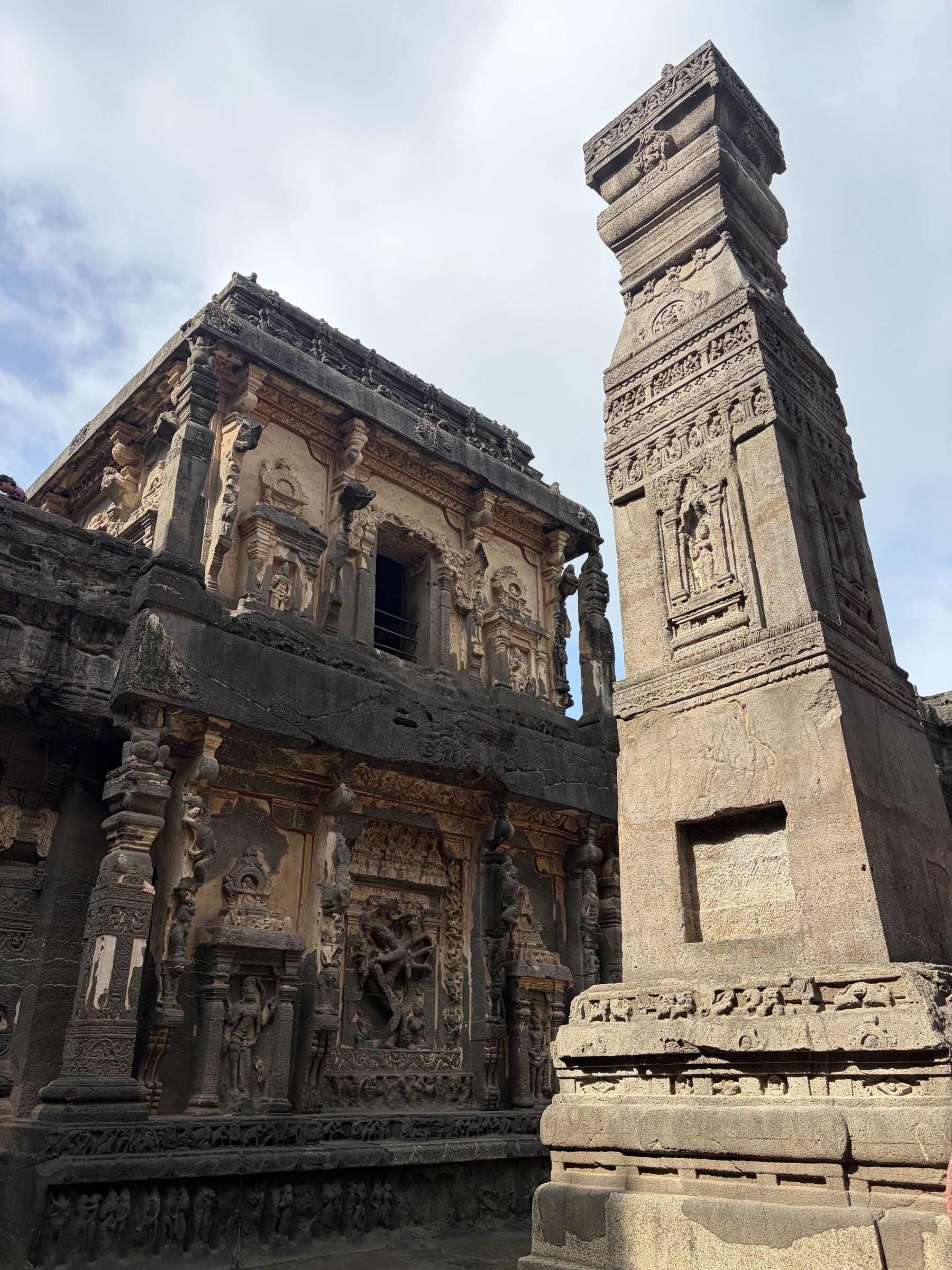
- Day 1Ellora and the Kailasa temple, carved top-down from one rock (closed on Tuesdays). Add Grishneshwar temple and Daulatabad Fort.
- Day 2Ajanta and the viewpoint (closed on Mondays). Start early: it's a long drive each way.
- Day 3Lonar Lake, a crater lake left by a meteorite. A long day trip, or one night there.
Watch the closing days
Ellora is closed on Tuesdays and Ajanta on Mondays. Plan so neither falls on its day off.
Short on time?
Ajanta alone is a long day trip from the city. Leave by 7 am to have the caves before the crowds.
Going to Ajanta? Tell us which cave got you.
Follow @thecurryandpho on Instagram for more places like this, from India to Southeast Asia.
Follow on InstagramDates and details follow the commonly cited accounts. Some sources give 29 April 1819 or a different regiment for Smith. Distances and travel times are approximate, and timings, fees and rules change, so check with the ASI before you travel.